Licensed Clinical Social Worker, Certified Life, Executive, Health and Wellness, and Performance Coach
When most people think about Attention-Deficit/Hyperactivity Disorder (ADHD), they think of distractibility, hyperactivity, or impulsive behavior. While these symptoms are central to the diagnosis, researchers and clinicians increasingly recognize that many individuals with ADHD also struggle with something less widely discussed: emotional dysregulation.
Emotional dysregulation refers to difficulty managing emotional responses. It can involve feeling emotions more intensely, reacting more quickly, having trouble calming down after becoming upset, or experiencing frustration that seems disproportionate to the situation. Although emotional dysregulation is not currently included in the formal diagnostic criteria for ADHD, a growing body of research suggests it is a significant and common feature of the condition.
What is ADHD?
ADHD is a neurodevelopmental disorder characterized by persistent patterns of inattention, hyperactivity, and/or impulsivity that interfere with daily functioning.
It typically begins in childhood and often continues into adulthood. ADHD can affect academic achievement, work performance, relationships, and overall quality of life (National Institute of Mental Health [NIMH], n.d.; Centers for Disease Control and Prevention [CDC], 2026).

Historically, ADHD has been understood primarily as a disorder of attention and behavioral control. However, experts now recognize that ADHD also involves challenges with executive functioning—the mental processes that help us plan, organize, regulate behavior, and manage emotions.
Understanding Emotional Dysregulation
Everyone experiences strong emotions from time to time.
Emotional dysregulation occurs when a person has difficulty controlling the intensity, duration, or expression of those emotions.
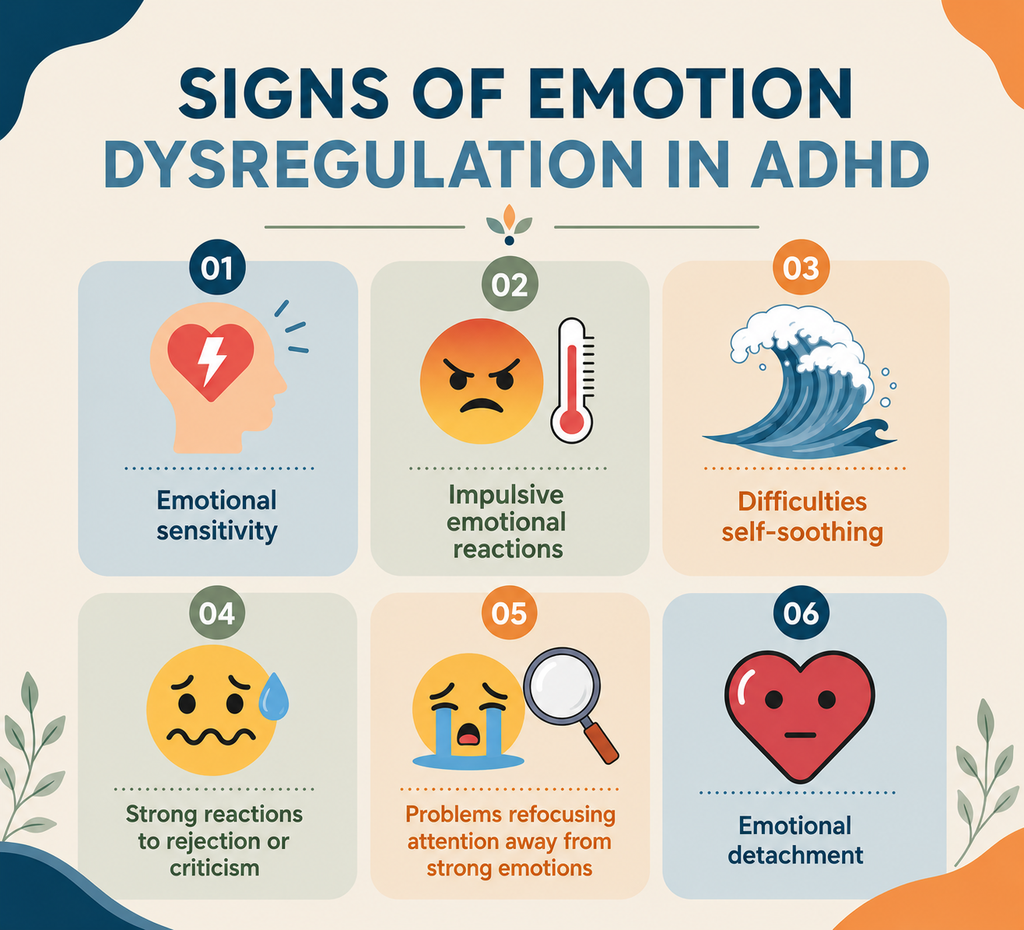
For individuals with ADHD, emotional dysregulation may look like:
- Becoming overwhelmed by frustration or disappointment
- Experiencing intense irritability
- Having emotional outbursts or “meltdowns”
- Struggling to recover after conflict or criticism
- Feeling emotions more intensely than others seem to
- Difficulty shifting from one emotional state to another
These reactions are not simply a matter of willpower or personality. Research suggests that differences in brain networks involved in attention, inhibition, and emotional processing may contribute to these challenges.
The Impact on Daily Life
Emotional dysregulation can affect nearly every area of life.
In children, it may lead to frequent conflicts with parents, teachers, or peers. A child who appears defiant or overly sensitive may actually be struggling to regulate emotions effectively.
In adults, emotional dysregulation can contribute to relationship difficulties, workplace challenges, low self-esteem, and increased stress. Some individuals describe feeling as though their emotions shift rapidly or become overwhelming before they have time to process them.
Treatment and Support
The good news is that emotional dysregulation can improve with appropriate support and treatment.
Effective approaches may include:
- ADHD medications, when clinically appropriate
- Cognitive Behavioral Therapy (CBT)
- Skills training focused on emotional regulation
- Parent training and behavioral interventions for children
- Stress-management techniques, mindfulness, and regular exercise
- Structured routines and environmental supports
How Amavi Can Help
If you, or a loved one, experience symptoms of ADHD, emotional dysregulation, or any other mental wellness challenges, please give Amavi a call and schedule a meeting with one of our practitioner’s.
We are always here to help.
References:
Beheshti, A., Chavanon, M.-L., & Christiansen, H. (2020). Emotion dysregulation in adults with attention deficit hyperactivity disorder: A meta-analysis. BMC Psychiatry, 20(120).
Centers for Disease Control and Prevention. (2026). Diagnosing ADHD. Retrieved from https://www.cdc.gov/adhd/diagnosis/
National Institute of Mental Health. (n.d.). Attention-Deficit/Hyperactivity Disorder (ADHD). Retrieved from https://www.nimh.nih.gov/health/topics/attention-deficit-hyperactivity-disorder-adhd
Soler-Gutiérrez, A.-M., Pérez-González, J.-C., & Mayas, J. (2023). Evidence of emotion dysregulation as a core symptom of adult ADHD: A systematic review. PLOS ONE, 18(1), e0280131.