By Allison Brudno, PMHNP – BC
Board-certified Psychiatric Mental Health Nurse Practitioner
These days, ADHD is everywhere: social media, articles, and friends or family discussing their diagnosis. At times, people may identify they have similar symptoms and wonder if they have ADHD too.
While it is important to understand that ADHD is present from childhood into adulthood, adult ADHD looks different than childhood symptoms. People may remember childhood struggles in school and at home, but were able to move through life by leaning on their parent’s structure and learning to “mask.” As adult work and life responsibilities accumulate, despite ADHD superpowers of problem-solving, creativity, and intelligence, people may feel they are having more and more difficulty managing it all, leading them to seek a diagnosis.
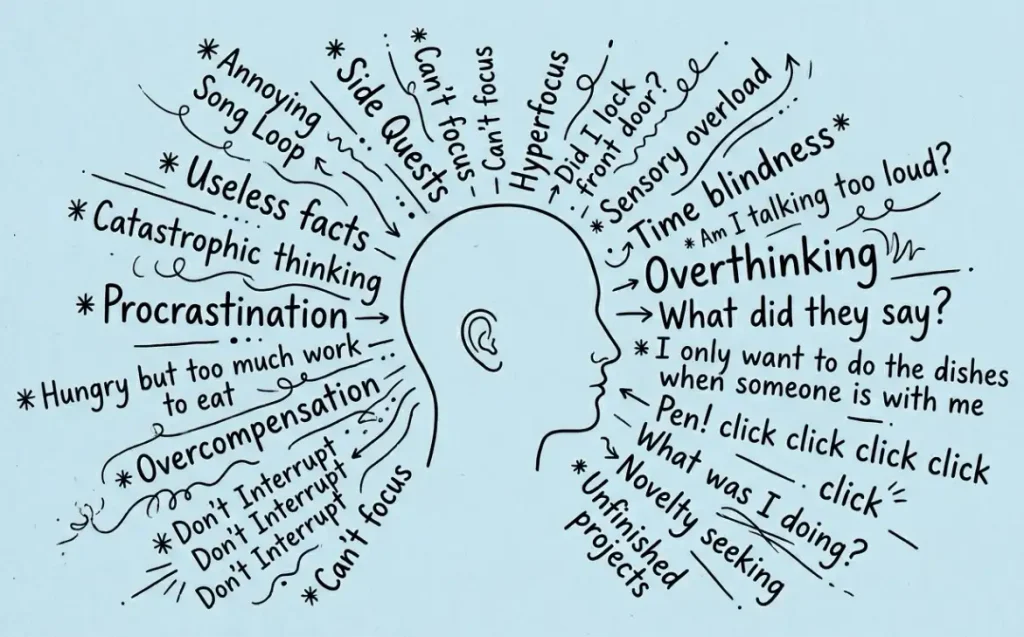
What Does Adult ADHD Feel Like?
People with ADHD don’t have enough dopamine and norepinephrine in their brain. These neurotransmitters are the key components for feeling reward, satisfaction, motivation, attention and focus. People with ADHD have to find a way to tap into these neurotransmitters to do things other people do easily. Something as simple as taking a shower can feel overwhelming at times, even when the desire is present to do it.
In adult ADHD, executive dysfunction becomes a core feature – the brain’s management system feels as if it is misfiring, making it difficult to plan, focus, remember instructions, and juggle multiple tasks. It disrupts the ability to initiate action, control emotions, and shift attention between tasks. Hyperactivity and impulsivity may or may not be present, but in adulthood it becomes more controlled, often with great internal effort. Fidgeting, near constant movement of a part of the body, talkativeness, frequently interrupting others, busy thoughts, emotional reactivity and feeling a need to always be doing something are often present.
Several conditions — perimenopause, insomnia, anxiety, depression, bipolar disorders, PTSD/trauma and others — can produce cognitive and behavioral symptoms that closely mimic ADHD. The key to differentiation lies in the course of the symptoms over a person’s lifetime. Other diagnoses that mimic ADHD symptoms tend to be episodic or have an identifiable onset.

How Amavi Can Help
The goal of Amavi’s providers is to thoroughly assess the patient’s experience, through observation, the interview, testing and even speaking with others in the patient’s life to collect a complete picture of what the patient has been living with across the lifespan.
It may take several appointments to complete, as diagnosis takes time. Medication may not be prescribed until a later appointment. It is common for patients to have multiple diagnoses at the same time, which may require management and treatment first before beginning to assess and treat ADHD.
Help and hope are available.
Many people who were never diagnosed in childhood have been able to receive a diagnosis and work closely with their provider to find the best medication and behavioral interventions to support symptom management.